
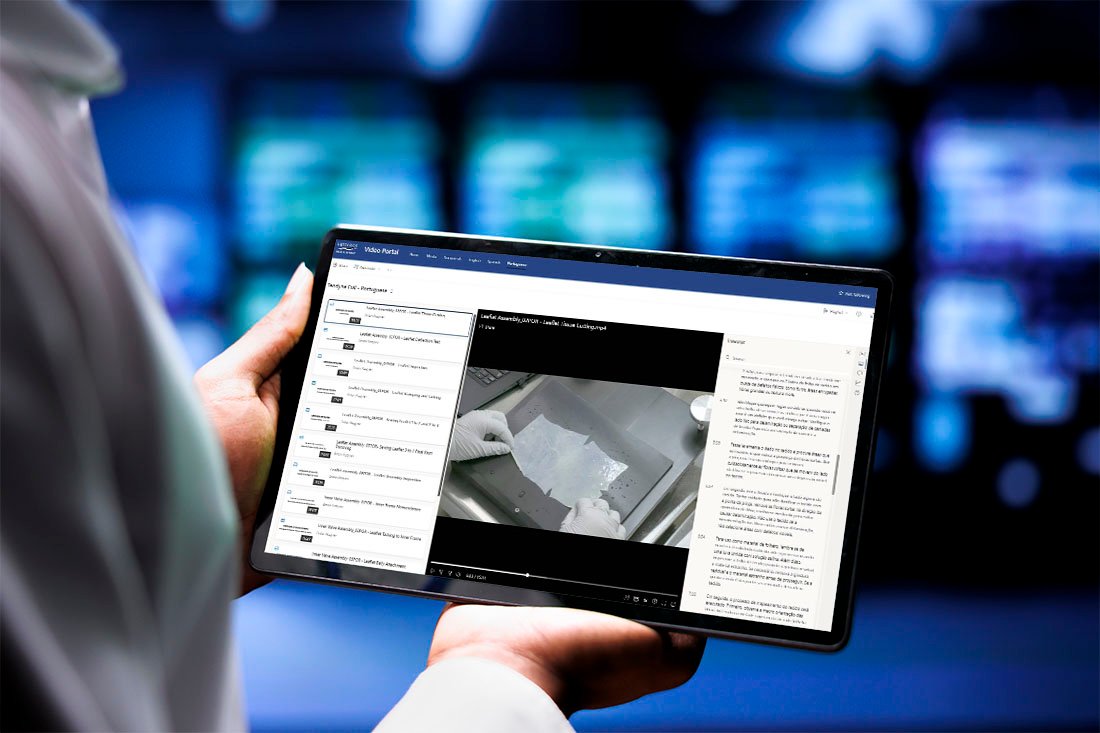
Picture the week a new production line goes live. Engineering has validated the process. Quality has approved the SOPs. And a new group of operators is about to hand-assemble a device smaller than a fingertip.
The written procedure tells them what to do. It can’t show how a veteran’s hands move, how a component looks when it’s seated correctly, or the exact moment where most errors begin. That knowledge lives in a handful of experienced people, and your ramp-up schedule depends on getting it into everyone else’s hands.
That is the real job of a training video in medical device manufacturing. It is also why “should we make it ourselves or hire a vendor?” is the wrong framing. There are three options, not two:
- In-house training video production,
- General video vendor,
- Specialist that understands manufacturing training.
Each wins somewhere, and knowing where is worth real money.
The numbers at a glance
83% of office workers surveyed across six countries said they prefer to get informational content as video, ahead of text (43%) and audio only (32%).
57% of video viewers say clarity is the most important factor in keeping them engaged.
91% of respondents watched instructional or informational videos at work at least monthly, and 71% did so weekly.
Training video is part of your quality system
In MedTech, a training video isn’t just communication. It provides documented evidence that people are competent to do their jobs. Since February 2, 2026, FDA’s Quality Management System Regulation (QMSR) has incorporated ISO 13485:2016 by reference into 21 CFR Part 820, and training and competence sit under ISO 13485 clause 6.2.(Source:FDA)
Inspectors do look at it. In 2021, lack of training documentation or inadequate training procedures was cited at 3.2% of all inspected device sites, and at 8.0% of sites that received at least one observation. (Source: faegredrinkerraps)
That raises the bar in several ways:
Accuracy is non-negotiable. A step shown incorrectly, or a video that no longer matches the current SOP, is a quality problem, not just a content problem.
Version control matters. Videos must trace to controlled documents and change when procedures change.
Audiences vary. Operators, inspectors, field engineers, clinicians, and end users need different depth.
Environments are demanding. Cleanrooms, gowning, and confidentiality rules trip up crews who have never worked in them.

Why Video
Your workforce is already asking for it. In TechSmith’s multi-country survey, 91% of respondents watched instructional or informational videos at work at least monthly, and 71% did so weekly. Respondents cited informal training videos (56%) and professionally produced training videos (54%) as the formats they used most. That last pair is relevant to this article’s question: employees use both kinds, so the real decision is which content deserves which treatment. Source: presseportalpresseportal
In House Team | General Video Vendor | Lightvision Media Group (specialist) | |
|---|---|---|---|
Process insight | Excellent: your SMEs know it best | Depends on how much SMEs hand-hold | Analyzes the process to find the yield-critical steps |
Fine-detail capture | Limited by equipment | Usually not equipped for micro-scale work | Built for it, including microscope capture |
Speed of updates | Fastest | Endless change orders and re-scoping cycle | Update support process developed and in place |
Secure delivery and control | Your own systems and infrastructure | Often a file hand-off. No Streaming System | Proprietary managed Content Distribution System with analytics tools |
Scale across lines and sites | Strained by capacity | Project by project | Designed as a sustainable program |
Best for | Fast-moving SOP updates | Brand, launch, marketing and event films | Ramp-ups, transfers, NPIs, Continuous Improvement, and standardization |

If your video is a brand piece, almost any good studio will do. If your video is part of your quality system and its job is to make every operator perform a hand-built procedure the same way, choose a partner whose core business is manufacturing training. A beautiful video that no longer matches the SOP is a liability.
Why Lightvision Media Group?
- Knowing the Process (not just filming it)
LightVision Media Group focuses on the process points that affect production yields and works with engineering and production teams to capture best practices and techniques that go beyond written procedures. Its method starts with analysis and discovery, including a projected ROI and value-stream analysis, before production begins. - Specialised Equipment
Much of device assembly happens under magnification, where a standard camera shows nothing useful. We use proprietary microscope camera systems to deliver the best quality video not accessible to most industry players. - 3D Animations
Visualizing what the eye can't see, it is usually used when filming isn't an option. A decade-long experience and pre-built asset library help to reduce costs and turnaround times. - Long-term Business Model
One video is a project. Fifty lines in several countries is a program that requires updates, support, and long-term partnership. Over a decade of operations, we developed robust methodology and expertise that we bring to the table. - Secure Content Delivery
We don't stop at post-production; we offer secure streaming to deliver training content to your Training Teams anywhere/amytime.
Five business cases where a specialist pays for itself
Not every video needs specialized video production. These five situations are where the stakes, the complexity, and the scale make the difference.
Production Ramp
The moment: Demand is climbing, and you need qualified operators fast.
What’s at stake:
Every week a new operator spends reaching proficiency is capacity you don’t have, and early variation shows up as yield loss.
What visual-based training does:
It gives every trainee the same close-up view of the technique from day one, so trainers aren’t the bottleneck and your best operators aren’t pulled off the line to demonstrate.
The specialist’s role:
Find the yield-critical steps, then capture them from multiple angles with operator commentary on the hard parts.
Product Transfer or NPI
The moment: A product moves from R&D to production, or from one site to another, perhaps overseas.
What’s at stake: Technique that lived in one team’s heads has to survive the move across sites, shifts, and languages.
What visual-based training does: It records the process as the originating team actually performs it, then gives the receiving site an identical reference.
The specialist’s role: Film on site wherever the process lives, and translate the result so each site trains in its own language.
Acquisition Integration
The moment: You acquire a company or line whose operators do the same job differently from yours. You need to capture it fast, while operators with the tribal knowledge are still available.
What’s at stake: Two techniques for one process, tribal knowledge nobody has written down, and output that varies by site. Or a preservation/transfer of the existing knowledge.
What visual-based training does: It documents the best technique, aligns it with the SOPs, and standardizes it across both teams. Transfers the new knowledge to the receiving site.
The specialist’s role: Work with engineering and production to decide which technique is the standard, then capture it so it can be taught the same way everywhere. Capture all valuable techniques and knowledge.
Quality and Inspection Training Validation
The moment: You need inspectors and operators to judge defects the same way, and you need to show training is standardized, especially in borderline cases and product handling techniques during the inspection process to prevent damage.
What’s at stake: Inconsistent acceptance decisions, escapes, and awkward audit questions about how you know people were trained alike.
What visual-based training does: It shows, via video, what acceptable and unacceptable look like at the magnification inspectors actually use. That trains the eye much better than a single image in the IP.
The specialist’s role: Quality assurance video and microscope capture, so the training shows what the inspector will see while handling the product correctly to avoid additional damage.
R&D-to-Production Handoff / Proof-Of-Concept Engineering
The moment: Engineering is proving a new process, and production has to inherit it. Engineering POC for budget approval presentation or any other audience.
What’s at stake: Problems found late on the line instead of early, and engineering intent lost in the handoff.
What visual-based training does:It records proof-of-concept builds so teams can review them, spot faults early, and give production a clear picture of what engineering intended.
The specialist’s role: Support R&D and POC engineering projects, and carry the same footage into production training later.
You don't need to choose just one
The strongest programs tend to be hybrid:
- Specialized Training Video Production Partner for the master content: flagship process videos, microscope capture, animation, and translation.
- In-house for the fast stuff: quick updates, refreshers, and routine SOP walkthroughs.
- Shared infrastructure: version control tied to your PLM, and a secure platform where your designated content manager controls access.
- General Video Production Studio: corporate videos, marketing presentations.
That puts your budget where polish and precision matter, and your internal expertise where speed matters.
Seven questions to ask any partner
- How will you learn our process before you film anything?
- Can you capture detail at the scale our operators work at?
- How do revisions work when an SOP changes, and how do versions tie to our controlled documents?
- How is content delivered and secured, and does it support SSO and access control?
- Who owns the source files, and can we edit them later?
- Have you worked in regulated manufacturing environments, and how do you handle confidentiality, gowning, and site access?
- Can you show a multi-site, multilingual program, and how do you measure its results?

A 60-second self-test
If you answer yes to any of these, a conversation with a specialist is worth having:
- Will you ramp a line, transfer a product, or integrate an acquisition in the next 12 months?
- Does critical technique happen at a scale a normal camera can’t show?
- Do you run multiple lines, sites, or languages that need identical technique?
- Will you have a mass training event in the next 12 months?
- Do you have any complex, technique-driven, high-cost, yield-critical production processes?
If your answers are mostly no and your procedures change weekly, in-house is probably the right call.
Planning a ramp, a transfer, or an integration?
In-house production wins on speed, control, and cost per update. Outsourcing wins on craft, scalability, and specialized capabilities. The right choice depends on how often the content changes, how critical it is, and what your team can sustain.
Whichever path you choose, remember that a training video in MedTech is part of your quality story, and inspectors will ask to see the records behind it. Accuracy, traceability, and clarity matter as much as production value.
At LightVision Media Group, we produce high-quality, customized video content that drives results in manufacturing.
With over a decade of experience in visual-based training and inspection content, we understand the unique challenges of manufacturing and the critical importance of consistency in quality control.
